Table Of Content

The house, which belongs to the National Trust for Historic Preservation, has been relocated twice and sits on the grounds of Woodlawn Plantation, Alexandria, Virginia. Along with the Andrew B. Cooke House and the Luis Marden House, it is one of the three homes in Virginia designed by Wright. We believe all Americans deserve to see their history in the places that surround us. Yet just a small fraction of the sites on the National Register of Historic Places represent women and people of color.
t Annual woodlawn Needlework Show
There is much to research, learn, and uncover, especially of the histories that are painful and difficult to discuss. Frank Lloyd Wright's Pope-Leighey House, which sits on the land of Woodlawn Plantation, is an interesting juxtaposition to the colonial mansion. Many innovative concepts, including spacious interiors, were quickly adapted across America.
Woodlawn & Pope-Leighey House frequently asked questions
Marjorie lived there until her death in 1983, at which point the home became a full-time museum. The Pope-Leighey House tells the story of Frank Lloyd Wright's innovative designs for modestly-sized and affordable single-family "Usonian" houses and how two families adapted this dwelling to fit their mid-20th century lifestyles. The Pope-Leighey House sits on the grounds of Historic Woodlawn and is open Friday through Monday (March through December only), offering guided tours every half hour from noon until 4 pm. Pope, a writer for the Washington Evening Star, had taken an interest in Wright’s architectural designs in 1938, and met him that same year during a presentation in Washington, D.C. While there, he implored Wright to build a home for him. Wright initially rebuffed him, but reconsidered after Pope wrote him a letter which stroked Wright’s ego and reiterated Pope’s desire to live in a home built by Wright.
Woodlawn Manor and Pope-Leighey House

Holding the distinction of being relocated twice, the house represents a continuing commitment by the National Trust to make this magnificent example of early Usonian design accessible to the public to enjoy. The women of Woodlawn understood the need to mend, but also appreciated the value of needle arts as a way of bringing beauty into their homes and their lives. Nelly Custis Lewis, granddaughter of George and Martha Washington, cross-stitched bookmarks in remembrance of her beloved grandparents. Women enslaved at Woodlawn, like Dolcey, her daughters Nelly and Sukey, and her niece Lucinda, passed down needlework traditions and techniques despite the demands made of them through bondage. Later, women of the Woodlawn Quaker Meeting stitched quilts as a way of maintaining community and family ties across generations. It is the mission of Woodlawn and Pope-Leighey House to engage with our community to preserve history and care for nature at this former site of enslavement.
A Brief History of Scent With Saskia Wilson-Brown
Now you can tour Alexandria's Frank Lloyd Wright-designed home virtually - Curbed DC
Now you can tour Alexandria's Frank Lloyd Wright-designed home virtually.
Posted: Thu, 08 Jun 2017 07:00:00 GMT [source]
Amazingly, none of the windows had received much more than cyclical maintenance since they were installed. 2012, therefore, was the year of the window campaign, as most of the windows were removed to a carpenter’s shop for full restoration. The exquisite craftsmanship and joinery of the original cypress windows held up well, and little new material was introduced during conservation. The shutters have also been restored and re-hung on the northwest elevation, which is the current public approach to the building.
Designing Immersive Gatherings With Zach Morris of Third Rail Projects
Reservations are recommended and tickets can be purchased online at woodlawnpopeleighey.org. This photo on the left illustrates the dramatic height difference between the now-oxidized gravel stop and flashing installed in the 1995 project and the bright new drip edge copper flashing installed this summer. The drip edge flashing ensures a waterproof seal above the perimeters' wood edging and directs any water away from the flashing. This new copper work provides a much slimmer profile along the roof’s edges, returning the home to a much better representation of its original construction and Frank Lloyd Wright’s design intent. In 1995, the home was moved a second time due to the instability of the soil beneath the foundation.
Visit Pope-Leighey House
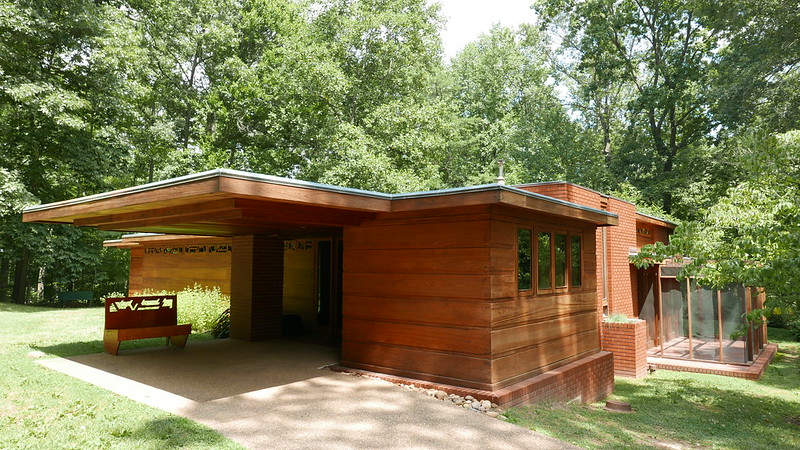
The home was built at its original location in 1941 in Falls Church, Virginia. The Pope family lived in the home from 1941 until 1946 when they moved to a large farm in Loudoun County. Wright's attention to function and form simultaneously meant his designs were rational while remaining artistic and decorative. Operated as a historic house museum since 1949, Woodlawn came to the National Trust for Historic Preservation shortly afterward. The home, which still sits on 126 of its original 2,000 acres, provides a base for innovative public programming based on its full history and the lives and contributions of all of its owners and inhabitants.
Some of the buildup from years of organic materials can be seen here, as well as the juxtaposition of the previous and newly installed flashing. Graham Gund Architect Mark Stoner and representatives of the contractor, Standard Restoration & Waterproofing review the planned work while scaffolding is erected. Scaffolding begins to be erected around the house, careful to avoid any close contact with the large windows. In 1939, a journalist by the name of Loren Pope commissioned Wright to design a home for him and his wife, Charlotte. They were struggling financially to bounce back from the Great Depression, which was the case for most people around the country, and had a modest budget for Wright to work with. Like many, the Popes needed to think about how everyday needs changed during financial crisis.
An Inside Look at Woodlawn's Captivating Story
It was completed in 1941, located at 1005 Locust Street, Falls Church, Virginia. Today, Woodlawn’s Needlework Show honors the needlework tradition and recognizes the importance it has had for countless men and women throughout time. By telling a fuller history at Woodlawn, we attempt to mend and make whole the fabric of a community in need of repair. We lift the lives and work of these women, and all who came before and after, so that their contributions may be recognized and celebrated. Needlework has been an integral part of the creation of everyday items, both as a form of function and of beauty, for thousands of years.
The Pope-Leighey House, formerly known as the Loren Pope Residence, is a “Usonian” style house constructed in 1941. The house was originally built for the Pope family in a series of middle-income residences that Wright designed and built. The house was relocated to the Woodlawn Estates when it was threatened by demolition to make way for Interstate 66 in 1961. Once construction was completed, Wright felt that the cost of the house had become too high. Concerned about the Popes' ability to afford the house, and determined to stick to his Usonian principle of accessibility for the middle class, Wright never requested his final payment.[4] Pope and his family moved into the house in 1941. First built in Falls Church, VA, the Pope-Leighey House was moved to Woodlawn in 1964 because it was at risk of being demolished by the Interstate 66 expansion.
Shortly thereafter, it was taken apart piece by piece, stacked onto a flatbed truck, and transported 13 miles to Woodlawn, where it was reassembled. Architect Ashley Wilson, former intern Rie Yamakawa, docent John Marshall, and former Silman engineering fellow Tenzin Nyandak in the main living space. For on-site director Amanda Phillips, the birthday sesquicentennial is a chance to bring new people to the house, which has a tendency to fly under the radar—even among Wright fans.
Due to the small interiors at Pope-Leighey and the popularity of the tour, tours are limited to no more than 16 visitors per group and therefore, there tends to be a longer waiting time on weekends. A National Trust Historic Site, this Usonian house was developed by Frank Lloyd Wright as a means of providing affordable housing for people of moderate means. Many innovative concepts, including spacious interiors, corner windows, and a cantilevered roof, began here and were quickly adapted across America. Today, the house can be viewed as an origin of ideas that have influenced modern American homes. Situated on 126 acres in Alexandria, Virginia are three pieces of very important and historic real estate.




No comments:
Post a Comment